

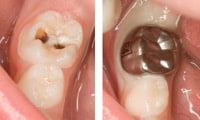
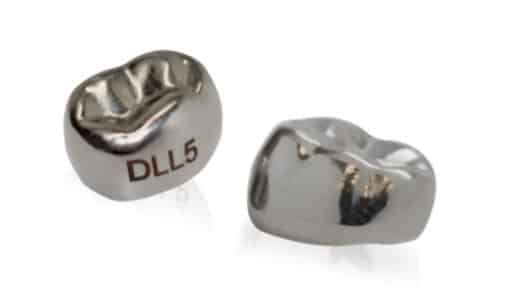
Stainless steel crowns are a common and ideal restorative treatment for baby teeth in children’s dentistry. They are pre-formed metallic caps that are fitted over baby molars. They help protect teeth and provide support from extensive decay or breakdown that remains on the teeth until they are lost naturally.

Stainless Steel Crowns are Recommended for Children
Stainless steel crowns are recommended for kids because they are very durable and have the highest success rate when compared to other restorative children’s treatments. They cover the entire tooth, completely sealing it from any damage. This greatly reduces a child’s risk of losing a tooth too early, which can create problems with space and the eruption of adult teeth which can lead to the need for orthodontic treatment or braces.
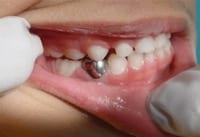
Stainless Steel Crown Procedure
This can be done one of two ways:
- Dental bands, known as spacers, are placed on either side of the tooth which will push the teeth apart creating space. This can be completed several hours or up to a week prior to the crown placement.
- Shrinking the size of the tooth by shaving off each side of the tooth. Once adequate space is achieved, a crown is picked by finding the right size that will fit the individual’s tooth. After the right size has been found, it is glued directly onto the tooth.
Every treatment plan is bespoke and thus outcomes are truly individual and vary. Please contact your dentist for further information.
Stainless Steel Crown FAQS
Q: How long does the crown last?
A: Stainless steel crowns remain on the tooth until the tooth is lost.
Q: Why is a crown better than a filling?
A: Fillings can be difficult to place in a child’s tooth due to their small mouths and limited compliance. They are more likely to wear quickly and leave un-restored areas on teeth, risking further decay and wear. Stainless steel crowns are made of a more durable material and cover the entire tooth, providing complete protection.
Q: Do crowns hurt?
A: Stainless steel crowns are a non-invasive treatment, and it doesn’t require the use of local anaesthetic which means no needles! However, the placement of both the crown and spacer bands does put a lot of pressure on the gums which can cause some tenderness for a couple of days afterward.
Q: How does the crown stay on the tooth?
A: They are cemented, or glued, onto the tooth with a special dental material.
Q: Does it affect their adult teeth underneath?
A: They do not have any effect on any other teeth.
COSTS: Approx $350
If you are an Existing or New Patient, we encourage you to contact us on (02) 4929 6007 and our incredible admin team will answer any further questions you may have.